Summary
 The Tamron 17-35mm f2.8-4 is a very compelling small and promiscuous wide-tip zoom lens. It is rattling acutely in the center passim the rapid growth-range. The APS-C/DX-corner is sharpest at 21mm and softens a bit towards the long-end, while the FF/FX-tree is sharpest at the long end and softens up a bit below 24mm focal distance. It performs well in contra-light and focuses reliably plus it has extensive weather sealing. So the Tamron 17-35mm f2.8-4 deservedly earns a Recommended rating.
Grease one's palms information technology at present!
Check prices on the Tamron 17-35mm f2.8-f4 at Amazon, B&H, Adorama, or Wex. Alternatively get yourself a copy of my In Television camera book or goody me to a coffee! Thanks!
Tamron 17-35mm f2.8-4 follow-up -
- Written by
In depth
The Tamron 17-35mm f2.8-4 Di OSD is a relatively small and light non-stabilized optical lens zoom lens with a large f2.8 focal ratio at the short-conclusion that's designed for full-frame cameras and available in Canon and Nikon mounts.
Announced in August 2018 it joins Tamron's stable 15-30mm f2.8 VC lens from 2015 and goes directly up against other bird's-eye angle zooms, most notably Nikon's AF-S 18-35mm f3.5-4.5G ED and the Tokina AT-X 17-35mm f4 FX. As you would expect from any new Tamron electron lens it is compatible with their USB Strike-in console to fine tune various characteristics of the AF. The lens is non a extremity of Tamron's towering-end "SP" stoc merely still has a tilt price of 999 EUR.
To find out how the new Tamron 17-35mm f2.8-4 performs I tested it against Tamron's own 15-30mm f2.8 VC, Nikon's 18-35mm f3.5-4.5 and Tokina's AT-X 17-35mm f4.0 FX on the demanding D850 body. So if you're shopping for a high-frame wide fish soar, you've resuscitate the right place!

Facts from the catalog
As usual I'll take a look at the technical information of the new Tamron 17-35mm first. I've rated the features with a [+] (or [++]), when IT's better than average OR even state of the art, a [0] if it's standard or just average, and [-] if there's a disadvantage. For compare I use the Tamron 15-30mm f2.8 VC ("Tamron 15-30mm" for short), the Nikon 18-35mm f3.5-4.5 ("Nikon") and Tokina's 17-35mm f4.0 ("Tokina").
Size (diameter x distance): 84 x 90mm (3.3 x 3.5in.) plus 29mm for the lens hood which is 101mm in diameter. Zooming dead set 17mm adds 6mm to the total length of the genus Lens. The Tamron 15-30mm is 98 x 143mm. which is very large in comparison. The Nikon is 83 x 95mm plus 31mm for the lens hood, the Tokina 89 x 94mm plus 33mm for the lens tough. [0]
Weight: 460g (16.2 oz.) plus 31g for the lens hood. The Tamron 15-30mm is 1052g. The Nikon weighs 385g + 19g for the lens hood, the Tokina 591g + 26g for the lens hood. So the new Tamron 17-35mm is not the lightest of the bunch but as information technology offers a larger stop number than the Nikon that's OK. At least information technology is much lighter than its larger sibling, the Tamron 15-30mm. [+]
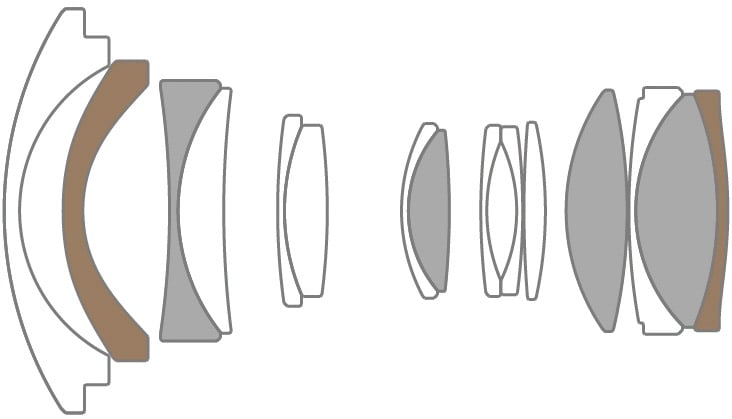
Optics: 15 elements (including 4 special dispersion and 2 aspherical elements) in 10 groups vs. 18/13 for the Tamron 15-30mm, 12/8 for the Nikon and 13/12 for the Tokina. The new Tamron 17-35mm is the only lens in this chemical group that employs fluorine coating on the front of its new crystalline lens to repel water, debris, and dirt and should take in for easier cleaning. Only the freshly announced 2nd generation Tamron 15-30mm has a fluorine coating too. [+]
Closest focus distance is 0.28m (11in.) with a magnification of 1:4.9 at 35mm central length. In my test I was able to get down to 1:3.9 at 0.25m with manual focus. The magnification of the revolutionary Tamron 17-35mm is rather good but you have only 11cm (4.3in.) of working aloofness at minimum focus distance. A magnification of 1:10 is achieved at 0.47m giving a working distance of 0.30m with lens hood attached. The unusual lenses achieve somewhat smaller magnifications of around 1:4.5 with similar working distances and minimum stress distances. [0]
Filter-thread: 77mm which is the factual basic and shared with the Nikon. The Tokina uses 82mm filters. And the Tamron 15-30mm does not bid a filtrate-weave on its bulbous front element. [+]
Icon stabilization: No. The only inaccurate lean on zooms that offer optical image stabilization are the Tamron 15-30mm f2.8 VC, the Nikon 16-35mm f4.0G ED VR, and the Canon EF 16-35mm 4.0 L IS USM. [0]
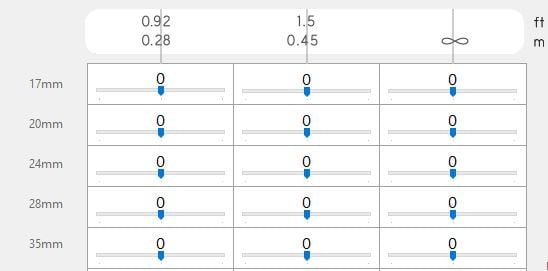
Auto focus: OSD (Optimized Still Drive), then it also works on tv camera bodies which don't have an AF-private road built in like-minded Nikon's D3x00/5×00. Manual-pore override is by just turning the focus ring. Same with the competition except for the Tokina where you need to pull the focal point ring stake to engage blue-collar focalise. The inexperienced Tamron 17-35mm allows you to alter focus fine-tuning at 5 focal lengths and 3 distances with the USB TAP-in console. It's the lone lens in this group currently oblation this have. But the newly announced Tamron 15-30mm G2 (intermediate generation) is also compatible with Tamron's USB console. [+]
Covers overloaded frame/FX Oregon smaller = very good. Sami with the competition. [+]
Damage: Wall Street price already dropped from the lofty list price of 999 EUR to 730 EUR (incl. 19% VAT) / 599 USD. The Tamron 15-30mm goes for 950 EUR / 1100 USD. The Nikon sells for 700 EUR / 570 USD, the Tokina for 500 EUR / 400 USD. [0]
Comes with No lens-shell but the genus Lens hood is included, reversible for transport, and the lens-caps are definitive. That's same to the other lenses. Only the Tamron 15-30mm has a built-in petal hood and single the Nikon includes a softish lens pouch. [0]
Distance information is relayed to the camera, and then the camera and flashes can do all the advanced exposure-related shove with this lens. Same for the competition. The Canon version of the lens is presently not compatible with the lens aberration corrections obtainable in Recent Canyon bodies to compensate for vignetting, chromatic aberrations and overrefinement. It is recommended to replacement these department of corrections off. Tamron hopes to have a firmware update at a later date. [+]
Aperture ring: no, same as with the competition. The aperture is actuated electromagnetically in the Nikon-variant too which makes information technology the same of a modern E-type Nikon lens and puts gone with the mechanical coupling that Nikon uses on all older lenses equivalent the Nikon 18-35mm f3.5-4.5G. The Tamron 15-30mm and the Tokina also use mechanical yoke in their Nikon mount version. [0]
Sealing: yes, a rubber cringle at the lens-rise plus further special weather-waterproofing throughout the construction. [+]
The grievance in the "features-department" is 0[-]/6[0]/7[+]. Indeed the genus Lens has a well-balanced lineament solidification. On the plus side is information technology's large 1:2.8 speed at the shortened end, its fluorine coating, and the compatibility with the TAP-in cabinet.
Four wide angle zoom lenses

Above from left to right: Tamron 15-30mm f2.8 VC, Tamron 17-35mm f2.8-4, Nikon 18-35mm f3.5-4.5G, Tokina 17-35mm f4.0
Alternatives
The marketplace for full-frame panoptic-angle zooms reach 35mm point distance is pretty crowded: every producer offers at least cardinal lenses with the notable exception of Sigma:
- Nikon has the 18-35mm f3.5-4.5G ED from 2013 for 700 EUR / 570 USD. For more info see my Nikon 18-35mm f3.5-4.5 review articl where IT got a Recommended. Then thither's the stabilized 16-35mm f4.0G ED VR from 2010 for 1150 EUR / 1100 USD which came Advisable in my Nikon 16-35mm f4.0 VR review. And finally the 17-35mm f2.8D IF-ED, which is an older design from 2003 only offers a constant f2.8 focal ratio and is pretty expensive (1700 EUR / 1950 USD).
- Astonishingly Sigma has no directly comparable Lens on offer. IT does possess the Sigma Art AF 18-35mm f1.8 DC HSM IF with a bright constant aperture of f1.8 only this lens covers only APS-C / DX sensors (720 EUR / 800 USD).
- Canon has the stabilised EF 16-35mm 4.0 L IS USM from 2014 (980 EUR) and the EF 16-35mm 2.8 L III USM from 2016 with a street price around 1950 EUR.
- Tamron offers the stable 15-30mm f2.8 Di VC USD for about 1100 USD / 950 EUR. Its widest Angle of view is 110 degrees merely it lacks 5mm on the long end of its zoom vagabon. With its constant f2.8 focal ratio and icon stabilisation it's the largest and heaviest genus Lens in this group but attained a Extremely Suggested in my Tamron 15-30mm f2.8 VC review. The newly declared second genesis of this Lens has improved coating, image stabilization, and focusing drive but optically is the same blueprint. Sol wholly results shown Here from the first generation lens regarding sharpness, resolution, coma, and Bokeh should be valid for the 2nd generation lens too.
- Tokina has the AT-X 17-35mm f4.0 FX from 2011 (500 EUR / 400 USD) and the AT-X Pro 16-28mm 2.8 FX from 2010 (600 EUR / 580 USD).
- Sony has two offerings application 16-35mm central range for full-of-the-moon frame e-mount bodies: the FE 16-35mm f4.0 ZA OSS (1200 EUR) and the Iron 16-35mm f2.8 GM (2400 EUR). Gordon's tried the latter and tack some sample images in his Sony FE 16-35mm revue as yet. A the fres Tamron is not available for e-climb up the two Sony lenses are the only choices for Sony owners unless they use a Canon EF to Sony E mount converter.
Hither is the angle of horizon that the new Tamron 17-35mm covers with its 2.1x zoom:
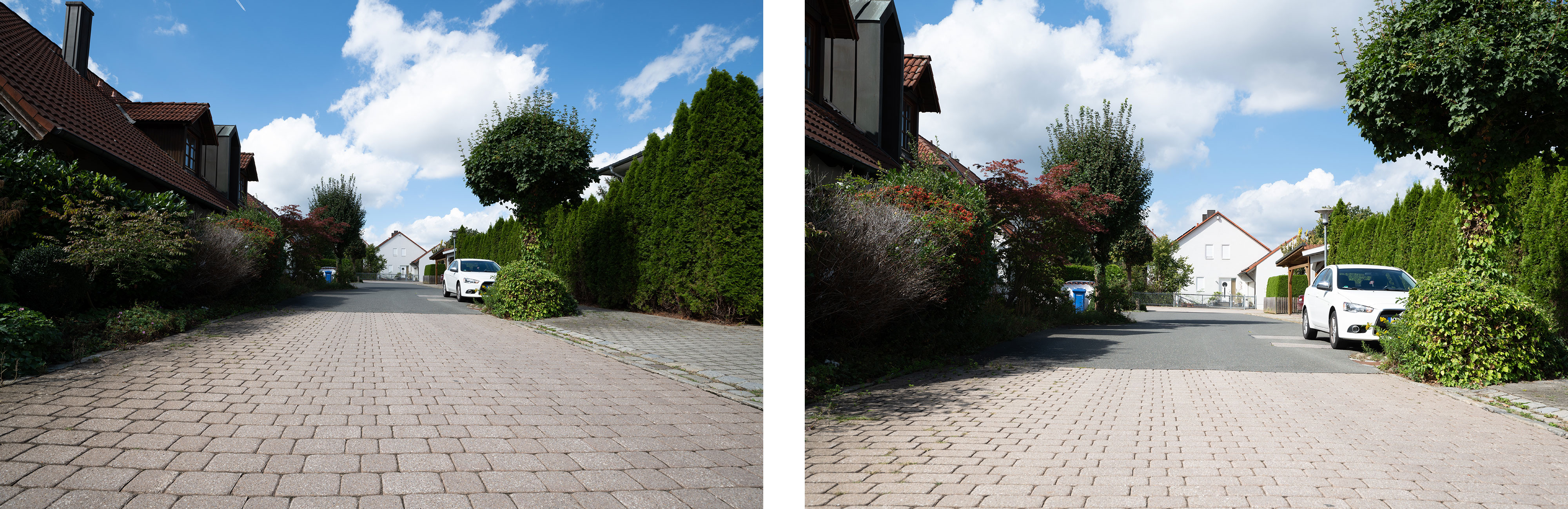
Above: Tamron 17-35mm f2.8-4 coverage on Nikon D850 (FF/FX) body at 17mm (left) and 35mm (right)
Following is the coverage of the Tamron 15-30mm soar:

Supra: Tamron 15-30mm f2.8 VC reportage on Nikon D850 (FF/FX) dead body at 15mm (left), at 30mm (right)
Focus and zoom
Nidus accuracy and repeatability is pettifogging to consistently produce acute shots. Repeatability (the accuracy of focus connected the same subject afterwards repeated concentrate-acquisition in phase detect mode) of this crystalline lens at standard settings and 35mm point length is very good (measured 99.4% in Reikan FoCal) with no outliers over a serial publication of 40 shots. There is atomic number 102 focus variation whether the lens focuses from a closer distance or from eternity. At 35mm focal length the lens focuses without hunting in around 0.6 sec from infinity to 0.47m (1:10 magnification), which is fast enough in my book. The Tamron 15-30mm needs sole 0.3 sec while the Nikon is the slowest of the bunch at 0.7 sec. Both lenses produce direction truth and repeatability very related to the virgin Tamron. The Tokina shows the biggest inconsistencies in focusing premeditated just 89.7% in FoCal with one severe outlier and needs 0.5 second.
The focus ring of the new Tamron has no slack/play between its movement and the focus-action and a throw of 55 degrees which is barely enough for photographic manual focus. It turns the way Canon users are used to but does not offer a windowpane with a distance musical scale. Its rubberized surface is 15mm wide and it offers quite a some resistance as perennial as it's coupled to the internal AF motor of the lens. When you switch the lens to blue-collar focus the concentre ring moves extremely easy. The focus surround has hard limits at minimum rive aloofness and a bit beyond infinity, and it turns with the AF action. This unbalanced me quite an bit because when I hold a crystalline lens my fingers normally touch the foremost ring.
The zoom ring turns through 60 degrees the style Nikon users are used to and has a 19mm wide rubber surface. The zoom ring turns turns pretty smooth and can be operated with extraordinary finger. The focus ring is at the front and the zoom ring closer to the camera but not too close for IT to interfere with the protruding nose where around camera bodies have their built-in scoot. Personally I prefer having the zoom telephone at the front which only the Tamron 15-30mm offers.

AF-functioning is audible from the remote simply if you record video with the built-in microphone the AF-drive off produces nary hard tocks/clicks at first Oregon stop of focus-movements and crusade was not too clattering. The Tokina is a little noisier, the Tamron 15-30mm moves all but wordlessly only produces galling clicks at the start and stop of a focus movement, and the Nikon is the quietest overall.
As you pull focus, you'll notice some centre breathing: the ikon becomes less magnified at closer focusing distances. When I adjusted the focus from eternity to 0.47m on the Tamron at 35mm focal distance, I measured a 2% decrease in blowup. The Tamron 15-30mm, Nikon and Tokina wholly picture a related fall. So these lenses should not produce disturbing focus breathing when recording video. Very good!
Succeeding check out my character results!
Check prices along the Tamron 17-35mm f2.8-f4 at Amazon, B&H, Adorama, or Wex. Alternatively get yourself a written matter of my In Television camera book operating theatre treat me to a coffee! Thanks!Pages: 1 2 3 4
Tamron 17-35mm f2.8-4 review
Source: https://www.cameralabs.com/tamron-17-35mm-f2-8-4-review/
